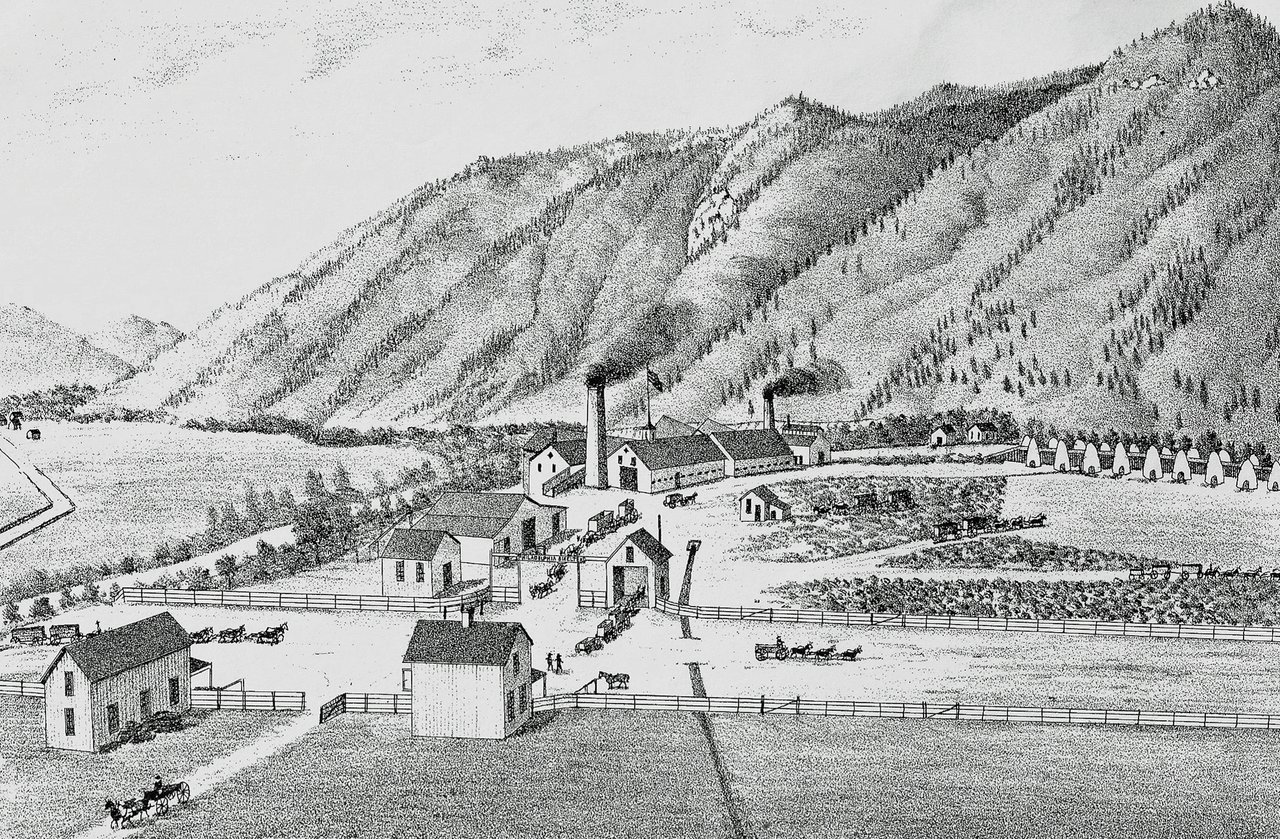
The Philadelphia Smelter: The Ketchum Enterprise That Helped Shape Sun Valley
Recently, I had the opportunity to attend a presentation at The Community Library by historian and author John W. Lundin, who shared his extensive research on the Philadelphia Smelter and its role in the early history of Ketchum and the Wood River Valley.
Lundin’s research brings to life a fascinating chapter of our local history. Built in 1881 by Philadelphia investors, the smelter sat just north of Ketchum near the confluence of Warm Springs Creek and the Big Wood River. The owners invested approximately $500,000 in the operation, a remarkable sum for the time, and the smelter quickly became one of the most important businesses in the territory.
By 1883, it was processing ore from 52 mines and producing roughly 40 tons of bullion a day. It had become a major employer in Ketchum, with Edward Price, whose father managed the smelter for nearly a decade, later recalling that it “had the big payroll in Ketchum during the eighties.”
But perhaps the most interesting part of Lundin’s research is what happened beyond the smelter itself.
When the Oregon Short Line Railroad reached Hailey in 1883, that was supposed to be the end of the line. The Philadelphia Smelter, however, was handling so much of the region’s ore, and represented so much business for the railroad, that the company pushed for the tracks to continue north. In 1884, the railroad was extended to Ketchum.
That decision would have consequences long after the silver boom ended.
In one of the most intriguing sections of his research, Lundin asks whether the Philadelphia Smelter actually helped make Sun Valley possible. More than 50 years later, when Averell Harriman was searching for a location for a major ski resort, Count Felix Schaffgotsch traveled by train into the Wood River Valley and ultimately found Ketchum ideal. Lundin makes the compelling case that if the railroad had stopped in Hailey, Ketchum may never have been considered for the resort that would eventually become Sun Valley.
The smelter itself was ultimately a short-lived chapter. As silver prices declined, the operation struggled and closed permanently in 1893. The boom that had transformed the Wood River Valley faded, and Ketchum entered a much quieter period.
Today, there is little left to see of the enormous operation that once stood along Warm Springs Creek. But John W. Lundin’s research gives us a much better understanding of just how important it was, not only to Ketchum’s mining history, but potentially to the story of how Ketchum became the place we know today.
I’m grateful to John for sharing his research at The Community Library and for doing the work to uncover and preserve these pieces of our local history.
Sources & Acknowledgment
Lundin, John W. The Philadelphia Smelter in Ketchum, Idaho: Center of the Region’s Mining Industry. 2025.
With appreciation to John W. Lundin for his research and for sharing this fascinating piece of Wood River Valley history.